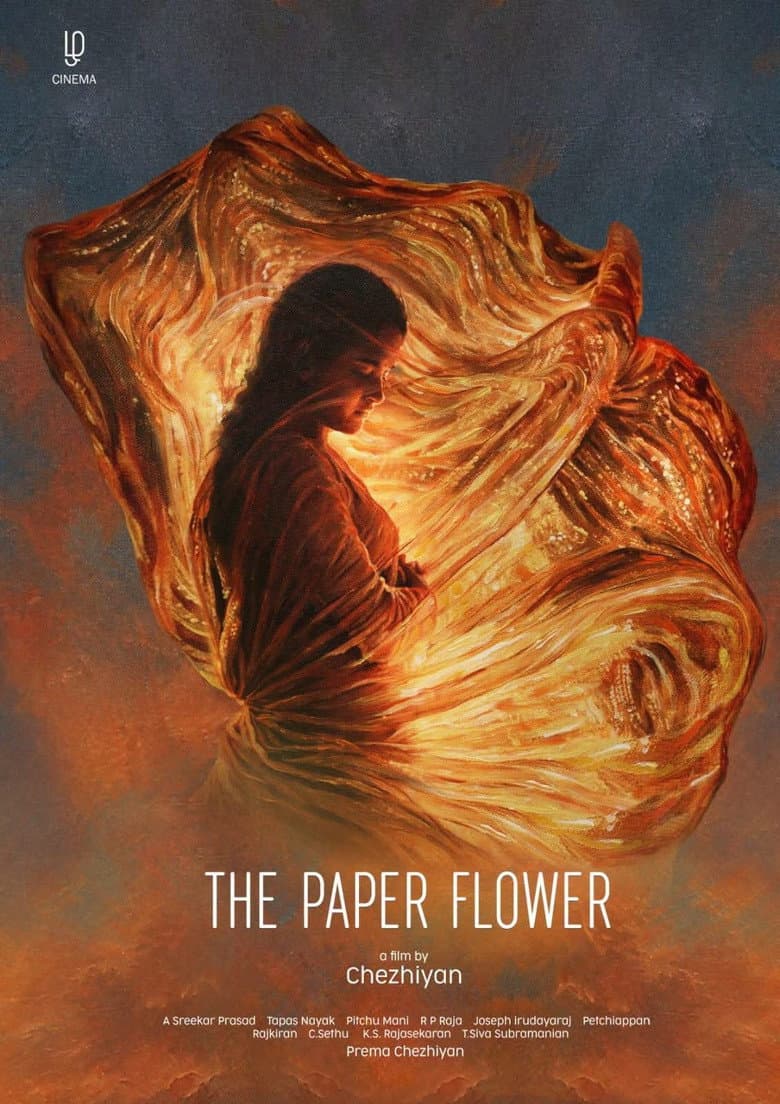
Chezhiyan has always been a director of textures, and The Paper Flower is his most restrained work yet. At seventy-five minutes it carries no excess; every scene feels pared down to its essential gesture. He shoots the fair as a living organism - the rustle of plastic covers, the smell of fresh print practically radiating off the frame, the way a spine cracked open can sound like a door. The camera lingers on hands more than faces, on the exchange of a book rather than the exchange of dialogue, and the effect is cumulative rather than immediate.
Parandhaga Cholan gives the artist an appealing stillness. His performance is built almost entirely from listening - the slight tilt of the head, the hesitation before a reply, the way he handles a book as though it might refuse him. Janani Shenbaga is the film's engine, warmer and more direct, and she locates the exact moment where fondness must decide whether to advance or retreat. Together they generate a chemistry that is genuinely platonic, which is far harder to play than attraction. The film's best passages are simply the two of them talking about literature, and the writing in those scenes has the unforced rhythm of real conversation.
Where the film stumbles is in its pacing, particularly through the middle stretch. Chezhiyan's patience is a virtue right up until it becomes a test, and there are passages where the atmosphere begins to circle rather than build. A few of the supporting figures at the fair register as scenery rather than people, and the deliberate avoidance of drama leaves a couple of scenes drifting without an anchor. The film also ends abruptly - deliberately so, one suspects, but it may leave some viewers checking whether the projection stopped early.
Still, the craft is undeniable. The sound design is exceptional, treating ambient noise as a score. The colour palette is muted to the point of near-monochrome in places, and it suits the material. For a film about paper, it has remarkable weight.